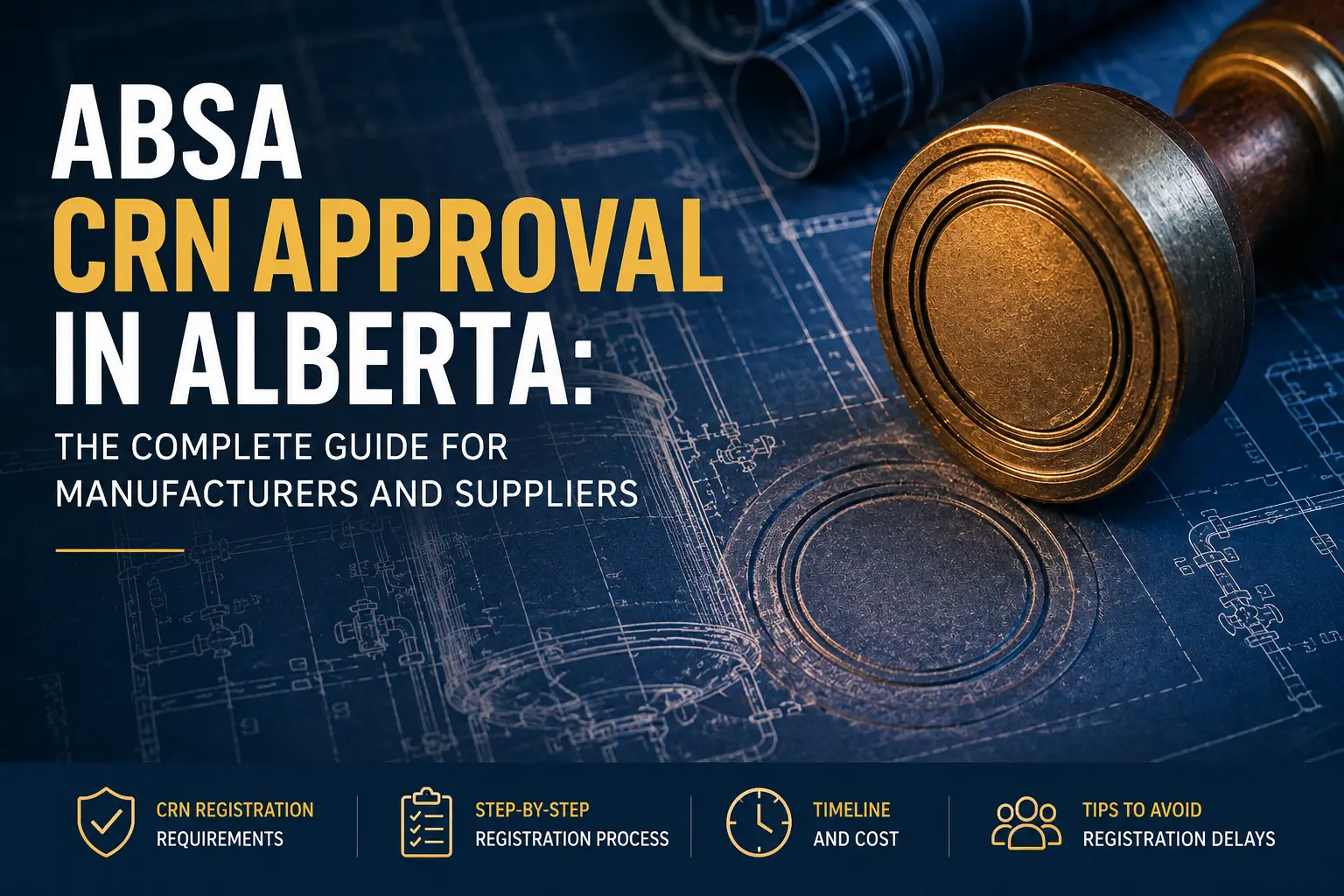
If you manufacture, fabricate, or supply pressure equipment for use in Alberta, you already know the province won't let it near a job site without one thing: a Canadian Registration Number. ABSA CRN approval in Alberta is often described as the strictest design review process in the country which is exactly why so many manufacturers underestimate how long it takes and how much documentation it actually requires. This guide walks through what CRN registration Alberta actually involves, what triggers the requirement, and how to avoid the delays that catch most first-time applicants off guard.
What Is a CRN, and Why Does ABSA CRN Approval in Alberta Matter?
A Canadian Registration Number (CRN) is a unique identifier issued once a pressure equipment design has been reviewed and accepted by a provincial regulator. In Alberta, that regulator is ABSA the Alberta Boilers Safety Association and no vessel, fitting, or piping system above the province's pressure threshold can legally be installed or operated without one.
The CRN isn't a manufacturing certification. It's a design registration. ABSA is confirming that the engineering behind a specific pressure vessel, fitting, or piping assembly meets Alberta's safety requirements not inspecting the physical unit itself. That distinction matters, because it means the quality of your submitted documentation determines how smoothly (or how slowly) the process goes.
Alberta is widely regarded across the industry as the most rigorous province to register with. Once a design clears ABSA's review, most other Canadian jurisdictions accept it with comparatively few additional questions which is why many manufacturers strategically start their national registration process in Alberta rather than treating it as just one province among several.
The Regulations Behind CRN Registration Alberta
CRN registration Alberta isn't a voluntary best practice it's a legislated requirement. Alberta's Pressure Equipment Safety Regulation (AR 49/2006), administered under the Pressure Equipment Safety Legislation (PESL, also referenced as AB-516), sets out the legal requirement for design registration before pressure equipment can be fabricated, installed, or operated in the province.
On the technical side, ABSA reviews submissions against the relevant ASME Boiler and Pressure Vessel Code sections and CSA B51, Canada's national standard for the construction and installation of pressure vessels, piping, and fittings. Reviewers commonly expect supporting calculations stress analysis, code-based design formulas, or finite element analysis for more complex or unlisted designs not just finished drawings.
What Equipment Actually Needs CRN Registration in Alberta
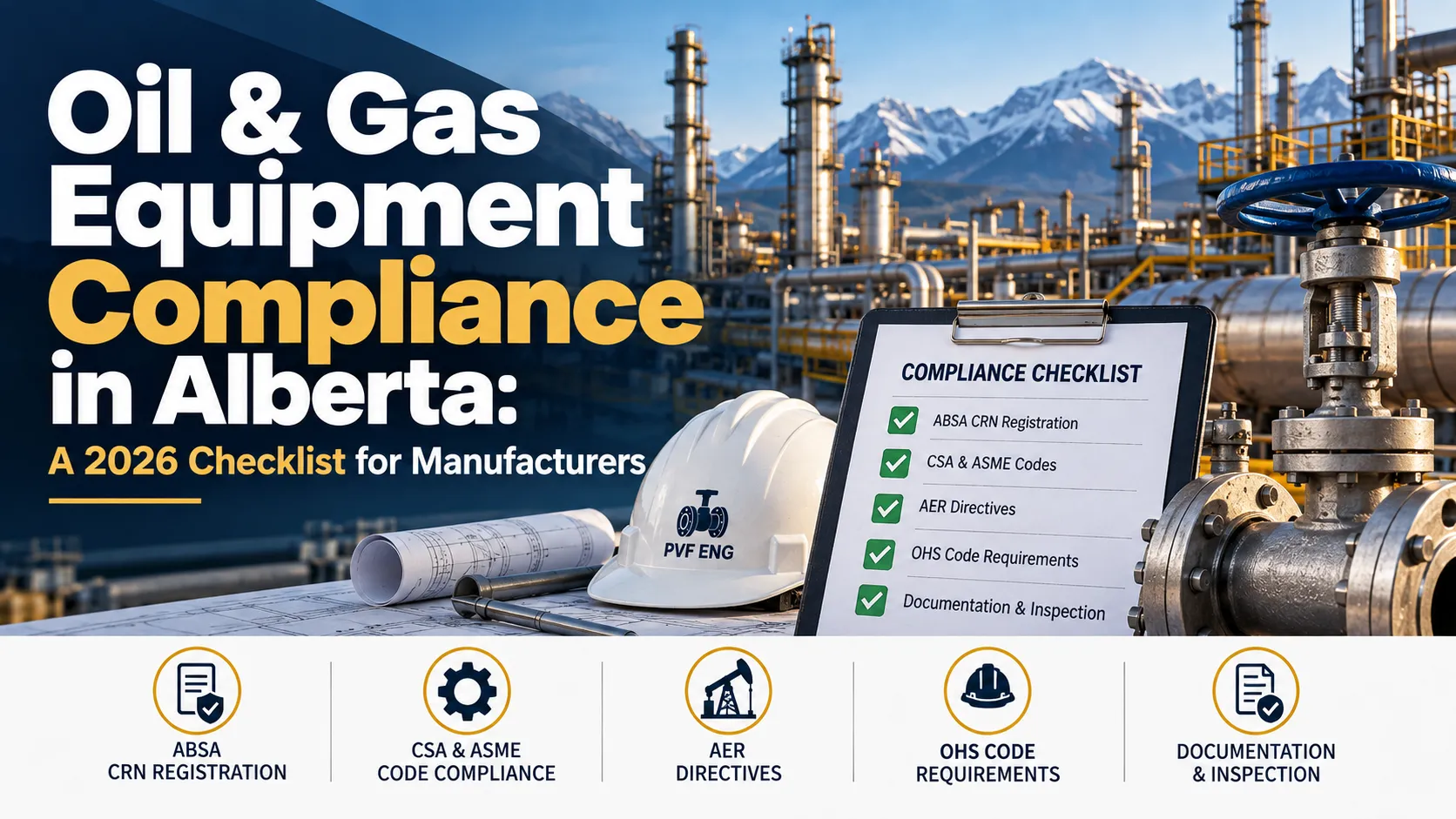
Not every fitting or vessel triggers the requirement. As a general rule, pressure equipment operating above roughly 15 psi and exceeding about 1.5 cubic feet in volume falls under CRN registration Alberta requirements though classification isn't always black-and-white. ABSA uses CSA B51's design figures to determine whether a smaller pressure vessel can instead be treated as a fitting, which changes the registration path.
In practice, this covers:
- Pressure vessels and heat exchangers
- Boilers and associated components
- Process piping systems and piping assemblies
- Valves, flanges, and other pressure-retaining fittings
- Skid-mounted systems combining several of the above
If you're unsure whether a specific component crosses the threshold, that's a question worth resolving with ABSA's Design Survey Engineers or an engineering partner familiar with the classification rules before you commit to a fabrication timeline.
How Long Does ABSA CRN Approval Take, and What Does It Cost?
This is where expectations and reality most often collide. Industry experience suggests a straightforward CRN registration Alberta submission can clear in as little as four to twelve weeks, but that's the optimistic end. Because Alberta's review process is thorough, and because incomplete submissions get sent back for revisions rather than approved with caveats, it's realistic to budget closer to several months particularly if any redesign is required mid-review.
Registration fees vary and ABSA doesn't publish a fixed national number, since costs differ by equipment category and, for multi-province filings, by jurisdiction. If you're planning to register the same design across Canada, budget for the fact that each additional province adds its own review and its own fee and a rejection in one jurisdiction can send you back to redesign for all of them.
The practical takeaway: engineering review before submission isn't a nice-to-have. It's the single biggest lever you have over your actual timeline.
The ABSA CRN Approval Process, Step by Step
- Design data intake.Drawings, material certificates, and applicable code calculations are gathered and checked for completeness before anything is submitted.
- Engineering review against ABSA's requirements.This is where gaps get caught — missing stress analysis, incomplete welding procedure specifications, or ratings that don't match the intended service conditions.
- Submission to ABSA.The completed package, including drawings signed and stamped by a Pvf Eng. where required, is filed for design registration.
- ABSA's Design Survey Engineer review.ABSA may request clarifications, additional calculations, or design changes this is the stage most submissions stall at if the documentation wasn't reviewed thoroughly beforehand.
- Query response and resubmission (if required).Technical queries need a fast, accurate response to avoid the process resetting.
- CRN issuance.Once accepted, ABSA issues the CRN and returns the stamped documentation set, which becomes the reference for both installation and any future multi-province registration.
Common Reasons CRN Applications Get Delayed in Alberta
Most delays trace back to the same handful of issues: incomplete design calculations, welding procedure specifications that don't match the equipment, material certificates that don't align with the design drawings, or a design that technically meets code but wasn't documented in a way ABSA's reviewers can quickly verify. Fabrication starting before design registration is another common risk — technically permitted, but it exposes you to costly rework if ABSA later requires design changes.
The pattern across nearly every source we reviewed for this guide is the same: submissions reviewed for completeness and code compliance before they reach ABSA move faster than ones filed as a first draft.
Do You Need a Separate CRN for Every Province?
Often, yes though it depends on the jurisdiction. Several provinces participate in a reconciliation arrangement that accepts another province's review with reduced scrutiny. Alberta, notably, sits outside that arrangement, meaning a CRN issued elsewhere doesn't guarantee automatic acceptance here, and an Alberta-issued CRN doesn't automatically clear every other province either. Each jurisdiction still issues its own number, even when working from the same underlying design package. If you're planning national distribution, it's worth scoping multi-province registration from the outset rather than treating each province as a separate, later project.
Choosing the Right Engineering Support for CRN Registration Alberta
Given how much of the timeline comes down to documentation quality, the manufacturers who move through ABSA CRN approval in Alberta fastest are usually the ones who treat engineering review as step one, not damage control after a rejection. That means having someone check your calculations, drawings, and material data against ABSA's actual requirements — and staying engaged to handle technical queries directly rather than submitting and hoping.
Final Thoughts
ABSA CRN approval in Alberta is thorough by design, and that's not likely to change. The manufacturers who navigate it smoothly aren't the ones who get lucky they're the ones who front-load engineering review, understand the equipment thresholds that apply to their design, and plan realistic timelines instead of optimistic ones. Whether you're registering your first vessel or expanding an existing design across Canada, getting CRN registration Alberta right the first time is almost always faster than getting it right the second time.
Faqs About ABSA CRN Approval in Alberta
What is a CRN, and is it the same as a company certification?
No. A CRN registers a specific equipment design, not a company or facility. It confirms that a particular pressure vessel, fitting, or piping design has been reviewed and accepted by the province's regulator in Alberta, that's ABSA and can legally be fabricated and installed there.
How much does ABSA CRN approval cost in Alberta?
Costs vary by equipment category and complexity, and ABSA doesn't publish a single fixed fee. If you're registering the same design in multiple provinces, expect separate fees per jurisdiction, in addition to Alberta's own review costs. Getting a scoped quote based on your specific equipment is more reliable than relying on general estimates.
How long does CRN registration in Alberta typically take?
Simple, well-documented submissions can clear in a matter of weeks; more complex designs, or ones requiring revisions after ABSA's initial review, can take several months. The biggest factor within your control is submission completeness thorough documentation upfront consistently shortens the process.
What happens if my equipment doesn't have a CRN?
Pressure equipment without a valid CRN generally cannot be legally installed or operated in Alberta. Some fabrication can begin before registration, but doing so carries real risk if ABSA later requires design changes, completed fabrication work may need to be redone.
Does equipment sold into Calgary and Edmonton both require ABSA CRN approval?
Yes. CRN requirements apply province-wide under Alberta's Pressure Equipment Safety Regulation, so equipment installed in Calgary, Edmonton, or anywhere else in Alberta is subject to the same ABSA registration requirement.
Is ABSA CRN approval required for oil & gas equipment used in Alberta specifically?
Yes, and it's one of the most common categories for CRN registration Alberta submissions. Pressure vessels, piping, and fittings used in oil & gas operations including sour service applications are subject to the same ABSA review process as any other regulated pressure equipment.
Do international manufacturers shipping equipment into Alberta need ABSA CRN approval?
Yes. The requirement applies regardless of where the equipment was manufactured. Vessels or fittings built outside Canada and shipped into Alberta still need CRN registration before they can be installed or operated in the province.
If I already have a CRN from another province, do I still need separate ABSA approval for Alberta?
In most cases, yes. Alberta isn't part of the reciprocal reconciliation arrangement some other provinces use to fast-track each other's approvals, so a CRN issued elsewhere typically still requires its own ABSA review before the design is valid for use in Alberta.