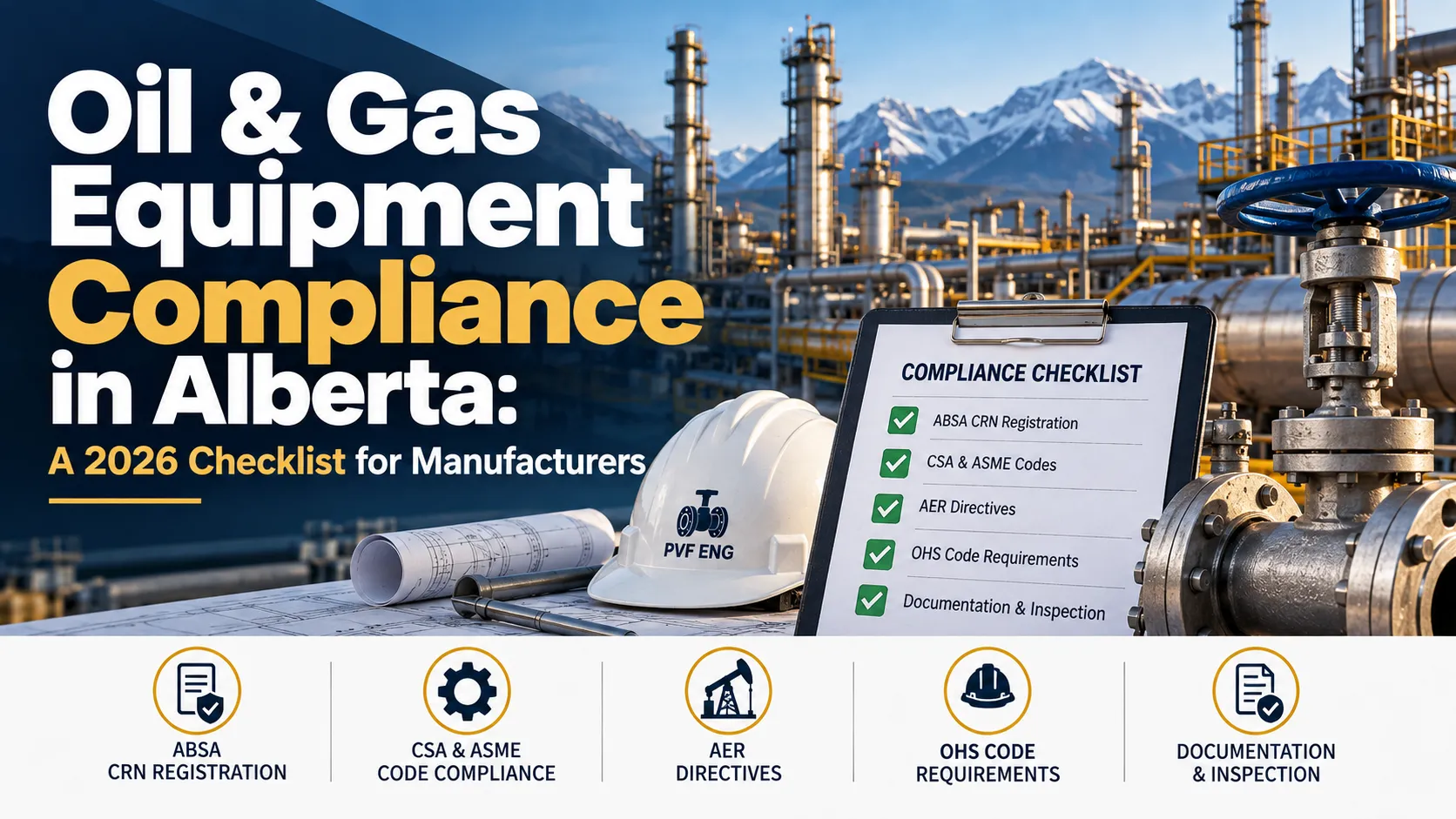
Manufacturing equipment for Alberta's oil and gas sector means answering to more than one regulator. Between ABSA's pressure equipment rules, the Alberta Energy Regulator's operational directives, CSA and ASME codes, and the province's Occupational Health and Safety Code, oil and gas equipment compliance in Alberta is genuinely more layered than in most other Canadian jurisdictions. This 2026 checklist breaks down what manufacturers actually need to have in place and where the gaps tend to hide.
Why Alberta's Compliance Landscape Is More Complex Than Most Provinces
Alberta's resource economy means ABSA processes an unusually high volume of pressure equipment registrations compared to most other provinces separators, treaters, line heaters, and skid-mounted process packages destined for sites around Fort McMurray, Grande Prairie, and Cold Lake all require design registration before they can be commissioned. The Industrial Heartland near Edmonton adds another layer, concentrating heat exchangers, reactors, and high-pressure piping systems that fall under ASME Section VIII and CSA B31.3 requirements.
That volume matters for manufacturers because it means Alberta's regulators and the third-party inspection agencies working under them see a wide range of equipment types daily, and applications that don't clearly meet the applicable code tend to get flagged rather than waved through.
The Core Regulatory Framework You Need to Know
Before working through the checklist itself, it helps to know which regulator covers what:
- ABSA (Alberta Boilers Safety Association) administers the Pressure Equipment Safety Regulation and CSA B51, covering boilers, pressure vessels, fittings, and pressure piping — this is where ABSA CRN registration comes in.
- The Alberta Energy Regulator (AER) governs operational aspects of oil and gas activity, including directives on well control equipment (Directive 036) and emissions/venting from process equipment (Directive 060).
- Alberta's Occupational Health and Safety Code, particularly Part 37, sets equipment requirements specific to oil, gas, and well servicing operations including drilling rigs, service rigs, and associated safety equipment.
- CSA B149 governs gas-fired appliances and equipment, a separate compliance track from CSA B51 pressure equipment even when the two apply to the same piece of process equipment.
A single skid-mounted package can fall under two or three of these simultaneously which is exactly where compliance gaps tend to open up.
The 2026 Compliance Checklist
1. CRN / Design Registration (ABSA)
Confirm every pressure-retaining component above Alberta's regulatory threshold vessels, fittings, and piping systems has a valid Canadian Registration Number before fabrication proceeds. Unregistered equipment cannot legally be installed or operated in the province.
2. Code Compliance for Construction (CSA B51 / ASME)
Verify the design and fabrication meet the applicable ASME Boiler and Pressure Vessel Code section, along with CSA B51 pressure equipment requirements this underpins the CRN registration itself.
3. Piping-Specific Code Compliance (B31.3 or Applicable Series)
For process piping, confirm compliance with the relevant ASME B31 piping code (commonly B31.3 for process piping), including required stress analysis documentation.
4. Gas-Fired Equipment Compliance (CSA B149)
If the equipment includes gas-fired components heaters, boilers, or combustion equipment confirm separate compliance with CSA B149, which is not covered by a CRN alone.
5. Manufacturer's Data Report
Ensure construction documentation, including a manufacturer's data report for vessels and boilers or a piping construction data report, is completed and retained this is required alongside design registration, not instead of it.
6. Authorized Inspection Agency (AIA) Sign-Off
Confirm inspections required under the Act are performed by an Authorized Inspection Agency where required, and that certificates of inspection or applicable exemption criteria are documented.
7. Alberta Quality Program (AQP) Certification, Where Applicable
For fabrication or vessel manufacturing operations, confirm whether an Alberta Quality Program certificate of authorization is required for your scope of work.
8. Welding Procedure and Welder Certification
Confirm welding procedure specifications and individual welders are registered with ABSA and hold the appropriate pressure certificates of competency for the work being performed.
9. AER Directive Compliance for Operational Equipment
Where equipment ties into operational activity well servicing, drilling, or gas venting confirm applicable AER directive requirements are addressed, such as Directive 036 for blowout prevention equipment or Directive 060 for vent gas handling on compressors.
10. OHS Code Equipment Requirements
Confirm equipment intended for drilling, service rigs, or well servicing meets the equipment-specific requirements in Part 37 of Alberta's OHS Code, including manufacturer specifications or professional engineer certification where load-bearing components are involved.
11. Manufacturer's Instructions on File
Alberta's OHS Code specifically requires equipment to be operated, maintained, and serviced according to manufacturer specifications meaning documentation needs to travel with the equipment, not just exist in a design file.
12. Multi-Jurisdiction Registration Planning
If the same design will be sold outside Alberta, confirm which other provinces require independent CRN registration versus which may accept Alberta's review with reduced additional scrutiny this affects both cost and timeline for national distribution.
Common Compliance Gaps Manufacturers Miss
The most frequent gap isn't ignorance of ABSA's CRN process most manufacturers know that's required. It's the secondary compliance tracks that get missed: gas-fired components that need separate CSA B149 compliance beyond the pressure vessel's CRN, AER operational directives that apply once equipment is in service rather than at the design stage, and OHS Code documentation requirements that are easy to treat as a customer's problem rather than something built into the equipment package from the start.
Equipment without a clearly applicable standard is its own category of risk. When a design doesn't fit neatly into an existing code, Authorities Having Jurisdiction generally still expect a documented, defensible approach to meeting an acceptable minimum safety standard silence on this point is treated as a gap, not a pass.
Building Compliance Into Design, Not Bolting It On After
The manufacturers who move through Alberta's regulatory layers most efficiently are the ones who scope CRN registration, code compliance, and AER or OHS considerations during the design phase not after fabrication is already underway. That's the same principle behind engineering-first valve design: catching a compliance gap on paper costs far less than catching it after equipment has already been built.
How PVF Engineering Supports Oil & Gas Equipment Compliance in Alberta
This is the exact intersection our oil and gas industry services are built around equipment design, engineering review, and compliance support scoped to the operating conditions and regulatory requirements specific to Alberta's oil and gas sector. Whether you're navigating ABSA CRN registration, CSA B51 and B31.3 requirements, or coordinating compliance across a skid-mounted package with multiple regulatory touchpoints, our oil and gas engineering team works through the full compliance picture rather than a single code in isolation.
Final Thoughts
Oil and gas equipment compliance in Alberta isn't a single checkbox it's a set of overlapping requirements across ABSA, the AER, CSA, ASME, and the province's OHS Code, and missing any one of them can hold up commissioning just as effectively as missing all of them. Building compliance into your design process from day one, rather than treating it as a final-stage formality, is the difference between a smooth path to market and a project stalled on paperwork.
FAQ About Oil & Gas Equipment Compliance
What's the difference between CRN registration and full oil and gas equipment compliance in Alberta?
CRN registration through ABSA covers design compliance for pressure-retaining equipment specifically. Full compliance for oil and gas equipment can also involve CSA B149 for gas-fired components, AER operational directives, and Alberta's OHS Code CRN is a necessary piece, not the entire picture.
Do I need an Alberta Quality Program (AQP) certificate to manufacture pressure equipment for Alberta?
It depends on your fabrication scope AQP certification covers specific activities like piping or vessel fabrication under a certificate of authorization. Whether it applies to your operation depends on what you're manufacturing and where; it's worth confirming during project scoping rather than assuming it does or doesn't apply.
What happens if my equipment meets CRN requirements but not AER operational directives?
Both are independently enforced. Equipment can be correctly registered for design under ABSA and still be non-compliant operationally if it doesn't meet applicable AER directive requirements once it's in service these are separate compliance tracks that both need attention.
How do I handle compliance for equipment that doesn't fit an existing standard?
When no directly applicable standard exists, the expectation from Authorities Having Jurisdiction is a documented, defensible approach that meets an acceptable minimum safety requirement often based on the closest applicable code or a professional engineer's certified specification, rather than an assumption that the gap means no requirement applies.
Does oil and gas equipment compliance in Alberta differ between Calgary-based and Fort McMurray-based operations?
The underlying regulatory requirements ABSA, AER, CSA, and OHS Code apply province-wide. What differs is often the equipment type and operating conditions: Fort McMurray and oil sands operations more frequently involve steam generation and pressurized slurry systems, while Calgary-area facilities skew toward a broader industrial and petrochemical mix.
Are compliance requirements different for equipment used in Alberta's Industrial Heartland near Edmonton?
The core requirements are the same provincially, but the concentration of petrochemical and refining activity near Edmonton means equipment there more frequently falls under ASME Section VIII and CSA B31.3 for high-pressure piping and heat exchangers specifically.
Do manufacturers based outside Alberta need to meet the same compliance requirements to supply equipment into the province?
Yes. Compliance requirements apply based on where equipment will be installed and operated, not where it was manufactured equipment built outside Alberta, including internationally, still needs to meet ABSA, CSA, and applicable AER requirements before commissioning in the province.
Is compliance support available for oil and gas equipment used in remote Alberta locations, like Grande Prairie or Cold Lake?
Yes. Compliance requirements and support aren't limited to major metro areas engineering and regulatory compliance support commonly extends to equipment destined for Grande Prairie, Cold Lake, and other regional oil and gas operating areas across the province.